
Can You Mount a TV Above a Fireplace? Houston Guide to Heat, Height, Brick & Hidden Wires

Updated: Sep 26
A television above the fireplace can create one clean focal point, but the wall is not automatically a safe mounting location. Heat, viewing height, the fireplace model, the wall structure, bracket leverage, and the power plan all matter before anyone drills.
Quick answer: You can mount a TV above some fireplaces, but only when the TV and fireplace manufacturers allow the setup, measured heat stays within the TV’s limit, the wall can support the selected mount, and power and AV cables can be routed correctly.
For Houston-area homeowners, the difficult part is not simply attaching a bracket. It is deciding whether the fireplace is a good TV location at all—and, if it is, choosing a setup that remains comfortable, serviceable, and clean.
Is It Safe to Mount a TV Above a Fireplace?
Sometimes. A safe answer depends on the exact TV, fireplace, mantel, wall, and room—not on a universal clearance copied from a decorating article.
Samsung’s current wall-mounting guidance says it does not recommend mounting a TV over a fireplace and states that its TVs should never exceed 104°F. It tells homeowners to operate the fireplace and check the temperature before considering the location. See Samsung’s official wall-mounting guidance. Other TV brands and models can have different operating limits, ventilation requirements, and warranty terms, so the manual for your exact model controls.
Fireplace design matters too. Some modern fireplaces offer heat-management systems specifically designed to redirect heat so a TV or artwork can be installed closer above the unit. Napoleon’s heat-management overview is one example. That does not make every fireplace safe for a television; it proves why the fireplace model and installation manual must be checked.
Do not assume gas, electric, or wood-burning automatically means safe or unsafe.
Do not use one fixed number of inches for every fireplace.
Do not rely on the fact that a previous homeowner already mounted a TV there.
Do not treat a mantel as guaranteed heat protection without verifying the fireplace instructions and actual temperature.
Start With the Two Manuals, Not the Drill
Before selecting a bracket or measuring the centerline, check both the TV manual and the fireplace installation or owner’s manual. You need the TV’s operating-temperature and ventilation requirements, plus the fireplace’s mantel, combustible-material, and heat-management clearances.
If the fireplace model cannot be identified, the honest answer may be to pause the installation until its requirements are confirmed. Guessing is especially weak when the unit is actively used, the firebox is close to the mantel, or the proposed TV location already feels hot.

How to Evaluate Heat Before Mounting
A quick hand test is not enough. Human comfort is not the same as an electronic operating limit, and temperature can change as the fireplace runs.
Identify the exact TV and fireplace models and read both manufacturers’ instructions.
Operate the fireplace under the normal conditions you expect to use after installation.
Check temperature where the television’s bottom edge and ventilation areas would sit, not only at the mantel.
Compare the result with the TV manufacturer’s stated limit and the fireplace’s required clearances.
If the location approaches the limit, lacks stable clearance, or depends on a guess, choose another wall or obtain a fireplace professional’s assessment.
A projecting mantel or a manufacturer-approved heat-management system may redirect heat, but neither should be treated as a substitute for the model-specific instructions. Wood-burning fireplaces also add ash and soot concerns around TV ventilation openings.
The Second Problem: A TV Above the Fireplace May Be Too High
Even when heat is acceptable, the screen can still be uncomfortable. A fireplace mantel often forces the television well above seated eye level. That can cause viewers to tilt their heads upward and can make the image look less natural during longer viewing sessions.
The best height is usually the lowest position that satisfies the fireplace and TV clearances while still fitting the bracket and soundbar. Seating distance, screen size, mantel height, and room layout all affect the result.
Fixed mount: clean and low profile, but it provides the least help when the screen is high.
Tilt mount: angles the screen downward and is often practical for a moderately elevated fireplace installation.
Full-motion mount: improves access and side-angle viewing but creates more leverage on the wall when extended.
Pull-down fireplace mount: may improve viewing height, but it must be compatible with the TV, fireplace use, clearances, and wall structure.
A bracket can improve the viewing angle, but it cannot fix unsafe heat exposure or weak structure. Mount choice comes after the location passes those checks.
Brick, Stone, Tile, or Drywall: What Changes?
The visible finish does not tell the whole story. A fireplace wall may contain solid masonry, masonry veneer, wood or metal framing, an air space, a chimney, a flue, utilities, or a combination. The attachment method must match what is actually supporting the load.
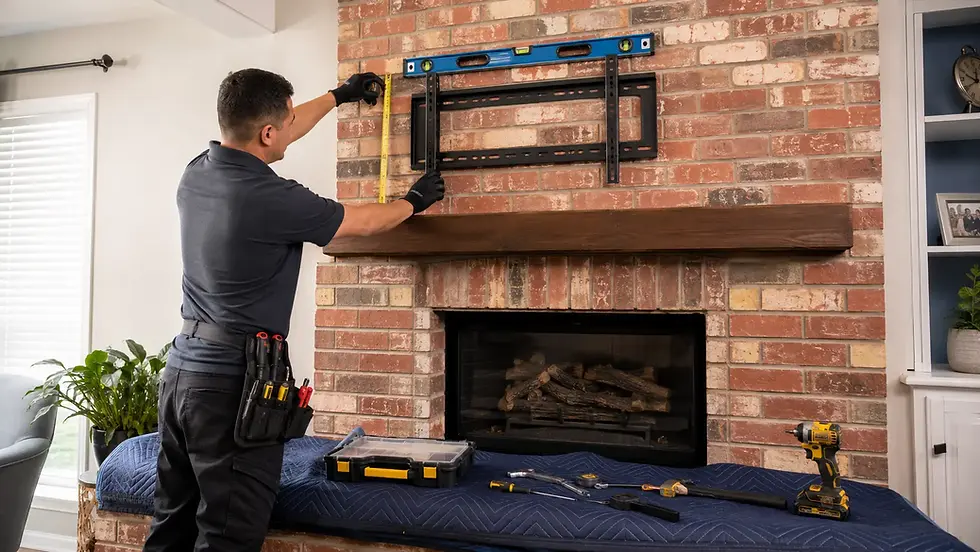
Brick: brick condition, depth, hollow areas, mortar condition, and the structure behind the veneer must be evaluated before choosing fasteners.
Natural or manufactured stone: uneven surfaces can affect bracket contact, leveling, drilling access, and wire routing.
Tile or slab: drilling can chip or crack the finish, and the installer still has to find suitable support behind it.
Drywall above a fireplace: stud locations may be unusual because of fireplace framing, vents, chases, or previous remodeling.
No installer should blindly drill toward a chimney or flue. If the structure or route cannot be confirmed, the plan needs to change.
How Can You Hide TV Wires Above a Fireplace?
Wire concealment should be planned before the TV goes up. Fireplace walls are often less forgiving than ordinary drywall because solid masonry, fire-rated assemblies, or fireplace components may block a direct cable route.

Existing outlet and low-voltage access behind the TV: usually the cleanest option when already installed correctly.
Listed in-wall power and cable-management system: a purpose-built solution may be used where the wall construction and product instructions allow it.
New or relocated receptacle: electrical work should be completed by a licensed electrician when required.
Paintable surface raceway: often the most practical, reversible option on solid brick or stone.
Low-voltage pass-through: HDMI, Ethernet, coax, and audio cables still need the correct in-wall rating and a route separated from heat and fireplace components.
A loose TV power cord or extension cord should not simply be dropped inside the wall. The U.S. Consumer Product Safety Commission describes extension cords as temporary-use products, and UL Solutions explains why listed cable and complete listed systems matter for field installation. Purpose-built products such as Legrand’s UL-approved in-wall TV connection kits illustrate the difference between a listed system and hiding an ordinary cord.
Fireplace TV Mounting Cost in Houston
AtoZ Local currently prices fireplace work from the standard TV-mounting rate plus the fireplace add-on. These are starting prices as of July 2026; brick, stone, tile, height, bracket type, wire routing, TV weight, and access can change the final quote.
Service | Starting price | Important condition |
TV mounting up to 60 inches | $100 | Standard mounting conditions |
TV mounting, 65–85 inches | $120 | Size, weight, wall, and height reviewed |
Large TV mounting, 86–100 inches | $250 | Usually requires advance review and may require a second technician |
Fireplace location add-on | +$40 | Added to the applicable TV-size rate |
Simple wire concealment | $70 | Depends on surface and cable route |
Advanced conduit or power bridge | $120 | Wall conditions and electrical scope reviewed |
Fixed / tilt / full-motion bracket | $45 / $55 / $90 | Compatibility and load rating must be confirmed |
For example, an uncomplicated fireplace installation for a TV up to 60 inches starts at $140 before the bracket, wire concealment, specialty surface work, or other required additions. Photos are the fastest way to determine whether the job fits standard pricing.
View the current fireplace TV mounting service and pricing or review TV mounting options for Houston and Katy.
When You Should Choose Another TV Location
The fireplace is not the right wall when the installation only works by ignoring heat, comfort, structure, or wiring. Choose another location when:
The TV or fireplace manufacturer prohibits the configuration.
Measured heat reaches or approaches the television’s allowed operating range.
Required fireplace or mantel clearances leave the screen uncomfortably high.
The mounting surface cannot be verified or supported for the TV and bracket.
The cable route would interfere with the firebox, chimney, flue, venting, or other fireplace components.
The only power plan is concealing an ordinary TV or extension cord inside the wall.
The television is too large for the available width, safe clearance, or handling conditions.
A different wall may produce a safer installation, better viewing height, easier service access, and lower cost. Forcing the TV above the fireplace is not automatically the premium choice.
What to Send Before Requesting an Estimate
For a faster and more accurate fireplace TV mounting estimate, send:
One wide photo showing the entire fireplace wall and seating area.
One close photo of the fireplace surface: brick, stone, tile, slab, or drywall.
TV brand, model, screen size, and approximate weight.
Fireplace brand and model, if available.
A photo of the existing outlet, cable openings, and nearby media equipment.
The bracket model or a photo of the bracket box if you already purchased one.
Whether the fireplace is gas, electric, or wood-burning and how often it is used.
Whether you want a soundbar, hidden wires, a surface raceway, or a new power location.
Houston, Katy, Richmond, Sugar Land, Cypress, Fulshear, West Houston, Memorial, Energy Corridor, and nearby homeowners can request a fireplace TV mounting estimate with photos.
Frequently Asked Questions
Can you mount a TV above a gas fireplace?
Possibly. The exact fireplace and TV manuals, mantel or heat-management design, measured temperature, wall structure, and viewing height must all support the setup. “Gas” alone is not enough information to approve it.
Is an electric fireplace automatically safe under a TV?
No. Many electric fireplaces direct heat forward and may be easier to plan around, but their outlet location, air discharge, required clearances, and manufacturer instructions still control.
Can a TV be mounted on a brick or stone fireplace?
Yes, when the masonry or supporting structure is suitable and the correct attachment method can be confirmed. Veneer, hollow brick, deteriorated mortar, uneven stone, and unknown chimney construction require extra review.
How high should a TV be above the mantel?
There is no universal height. The screen should be as low and comfortable as possible while meeting the fireplace manual, TV ventilation requirements, heat limits, mantel clearance, bracket space, and soundbar layout.
Does a mantel protect the television from heat?
A projecting mantel may redirect some rising heat, but it is not a universal guarantee. Its dimensions and required placement must match the fireplace manufacturer’s instructions, and the proposed TV location should still be evaluated under real operating conditions.
Can you hide the wires on a brick fireplace?
Often, but the cleanest method depends on the construction. Options may include existing access, a listed in-wall system where allowed, a new receptacle installed by a licensed electrician, or a paintable surface raceway. See AtoZ Local’s wire concealment options.
How much does fireplace TV mounting cost in Katy or Houston?
For a TV up to 60 inches under uncomplicated conditions, AtoZ Local’s current starting price is $100 plus the $40 fireplace add-on. Larger TVs start at higher base rates. Specialty surfaces, difficult height, brackets, wire concealment, soundbars, and second-technician needs are additional.
Plan the Fireplace Installation Before You Buy the Bracket
The right sequence is simple: verify the manuals, evaluate heat, decide the lowest comfortable height, confirm the structure, choose a compatible bracket, and settle the power and cable route. Only then should drilling begin.
AtoZ Local LLC has provided TV mounting and home-installation services in Greater Houston since 2017. If your fireplace involves brick, stone, tile, a large TV, hidden wiring, or an unusual wall, send photos and request an estimate before booking. Katy homeowners can also review the dedicated TV mounting in Katy, TX page.
Sources and Manufacturer Guidance
Samsung Support — Things to consider before mounting your Samsung TV to a wall
Napoleon — Fireplace heat-management systems
UL Solutions — Wire and Cable Application Guide
Legrand — In-Wall TV Connection Kit
U.S. Consumer Product Safety Commission — Household Extension Cords Can Cause Fires
Samsung Support · Napoleon · UL Solutions · Legrand · CPSC

